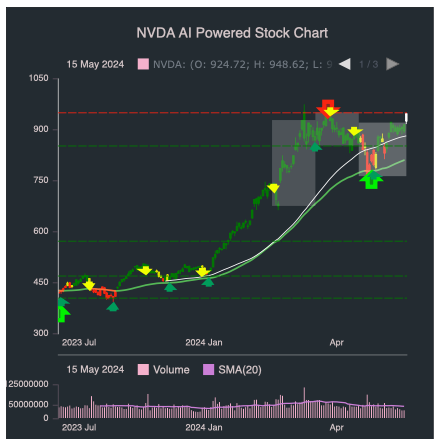
In order to obtain accurate valuable, reliable and accurate insights, you need to test the AI models and machine learning (ML). A model that is poorly designed or has been exaggerated can result in inaccurate forecasts and financial losses. Here are the top 10 tips for evaluating AI/ML models on these platforms.
1. Know the reason behind the model as well as the way to apply it.
Clarified objective: Determine the purpose of the model, whether it is to trade at short notice, investing long term, analyzing sentiment, or a way to manage risk.
Algorithm Transparency: Check if the platform is transparent about what kinds of algorithms they employ (e.g. regression, decision trees neural networks or reinforcement-learning).
Customization. Assess whether the model's parameters are tailored according to your own trading strategy.
2. Evaluation of Model Performance Metrics
Accuracy Check the model's predictive accuracy. Don't solely rely on this measure however, as it may be inaccurate.
Recall and precision - Assess the ability of the model to detect true positives and minimize false positives.
Risk-adjusted returns: See whether a model's predictions yield profitable trades taking risk into consideration (e.g. Sharpe or Sortino ratio).
3. Make sure you test the model using Backtesting
Backtesting your model with previous data lets you evaluate its performance against previous market conditions.
Testing using data that isn't the sample is important to avoid overfitting.
Analysis of scenarios: Check the model's performance during various market conditions (e.g., bull markets, bear markets, high volatility).
4. Check for Overfitting
Overfitting signs: Look for models that perform extremely well on training data but poorly on unseen data.
Regularization methods: Check the application uses techniques such as L1/L2 regularization or dropout in order to prevent overfitting.
Cross-validation is an essential feature for any platform to use cross-validation when assessing the generalizability of the model.
5. Assess Feature Engineering
Important features: Make sure that the model includes meaningful features (e.g. price or volume, as well as technical indicators).
Select features with care Make sure that the platform will contain data that is statistically significant and not redundant or irrelevant ones.
Updates to features that are dynamic Test to determine how the model adapts itself to new features, or market changes.
6. Evaluate Model Explainability
Model Interpretability: The model needs to be able to provide clear explanations for its predictions.
Black-box Models: Be cautious when you see platforms that use complicated models with no explanation tools (e.g. Deep Neural Networks).
User-friendly insights: Find out if the platform offers actionable insights in a format that traders can understand and apply.
7. Examining Model Adaptability
Market conditions change - Check that the model can be adjusted to the changes in market conditions.
Continuous learning: Ensure that the platform updates the model by adding new information to enhance the performance.
Feedback loops. Ensure you incorporate user feedback or actual results into the model to improve it.
8. Check for Bias or Fairness.
Data bias: Ensure that the data on training are representative of the market and free of bias (e.g. excessive representation in certain segments or time frames).
Model bias: Verify if the platform actively monitors the biases in the model's predictions and reduces them.
Fairness: Check that the model does favor or defy certain stocks, trading styles or particular segments.
9. Examine the Computational Effectiveness
Speed: Check whether the model produces predictions in real-time with minimal latency.
Scalability - Ensure that the platform can handle large datasets, multiple users and not degrade performance.
Resource utilization: Find out if the model uses computational resources efficiently.
Review Transparency Accountability
Model documentation - Ensure that the model's documentation is complete information about the model, including its design, structure as well as training methods, as well as limitations.
Third-party Audits: Check whether the model has independently been verified or audited by third parties.
Error handling: Determine whether the platform is equipped to identify and fix models that have failed or are flawed.
Bonus Tips
User reviews and case study: Use user feedback and case studies to assess the performance in real-life situations of the model.
Trial period - Try the demo or trial version for free to test the model and its predictions.
Support for customers - Make sure that the platform is able to provide a robust support service to help you resolve technical or model related issues.
These guidelines will help you assess the AI and machine learning models used by platforms for prediction of stocks to ensure they are transparent, reliable and compatible with your objectives in trading. Follow the best best ai stock trading bot free for site tips including best ai stock, ai stock, best ai trading software, ai investing platform, ai for stock predictions, ai stock market, ai investing, ai chart analysis, best ai stock trading bot free, ai investment platform and more.

Top 10 Tips For Evaluating The Social And Community Features Of Ai Stock Prediction/Analyzing Trading Platforms
Understanding how users communicate, interact, and learn is crucial to understanding the AI-driven trading and platform for stock predictions. These features can enhance the user experience by offering helpful support. Here are the top 10 ways to evaluate the social and community elements of such platforms:
1. Active User Communities
Check to see whether there's an active user community that engages regularly in discussions and shares knowledge.
Why An active community active is a place where users are able to learn and grow with each other.
2. Discussion Forums and Boards
Tips: Check out the quality and engagement levels in message board.
Forums allow members to talk about market trends as well as ask questions and discuss strategies.
3. Social Media Integration
Tips: Make sure the platform is linked to social media platforms for sharing insights and updates (e.g. Twitter, LinkedIn).
Why: Integration of social media with other platforms can boost engagement and provide information on market trends in real-time.
4. User-Generated Materials
Search for features that permit users to share, create and edit content.
The reason: User-generated content promotes an environment of collaboration and offers different perspectives.
5. Expert Contributions
Tip: Make sure the platform features contributions by experts in their field for example, AI or market analysts.
Why: Expert insights add credibility and depth to the community discussions.
6. Chat and messaging in real-time.
Tips: Make sure that you can instantly communicate between users by evaluating the real-time chat and messaging options.
Why is this? Real-time interaction facilitates rapid information exchange as well as collaborative work.
7. Community Modulation and Support
TIP: Check the level of moderating and support offered in the community (e.g., moderators, support staff, etc.).
What is the reason? Moderation is crucial to ensure a positive and respectful environment. Support helps users resolve their issues as swiftly as is possible.
8. Events and Webinars
Tip Check whether the platform hosts live Q&As with experts or hosts webinars.
What are they: They provide an opportunity for industry professionals to network with fellow participants and gain knowledge from them.
9. User Reviews and Feedback
Look for options that allow users to give reviews and feedback on the platform or its community features.
The reason: Feedback from users is used to identify strengths and areas for improvement in the community environment.
10. Rewards and gaming
Tip: Check if there are gamification features (e.g. badges or leaderboards), or rewards for participating.
Gamification is a great way to increase engagement of users with the community.
Bonus Tips on Security and Privacy
Check that all community or other social features have robust privacy and safety measures to safeguard users' information and their interactions.
You can look at these factors to determine if you're capable of finding a platform that offers a supportive active community that can help you improve your trading skills and knowledge. See the best chart analysis ai hints for more examples including chart ai trading, stock predictor, chart ai trading, ai options, best ai stock prediction, can ai predict stock market, ai tools for trading, best ai stock prediction, best ai stocks to buy now, ai for trading stocks and more.